 Italiano

Construction product manufacturers (‘manufacturers’) frequently provide free continuing professional development (CPD) content. The information is often the first that building designers and other specifiers (‘designers’) receive about a particular product. Designers may then seek further information and advice from manufacturers, including literature, standard details, and specification sections for the selected products, so that they can be incorporated into a project’s technical drawings and specification.
The information received can significantly influence design development and decisions made throughout the procurement process. If a problem arises from a specification incorporating information received from the manufacturer that causes a loss to the designer’s client, the client will most likely hold the designer accountable – not the manufacturer. This is particularly true where a clear contractual relationship exists between the client and the designer, but not between the client and the manufacturer.
Since the Grenfell Tower Fire
Following the Grenfell Tower fire on 14 June 2017, many of the long-standing norms in the construction industry have been scrutinised and found wanting.
In ‘Building a Safer Future‘ published in May 2018, Dame Judith Hackitt highlighted the complexity of construction product testing, labelling, and marketing that designers must navigate, stating that:
“The system that covers product testing, labelling and marketing is at least as complicated as the entire regulatory system […]. It is apparent that the current system makes it difficult to know whether the right products are being used.”
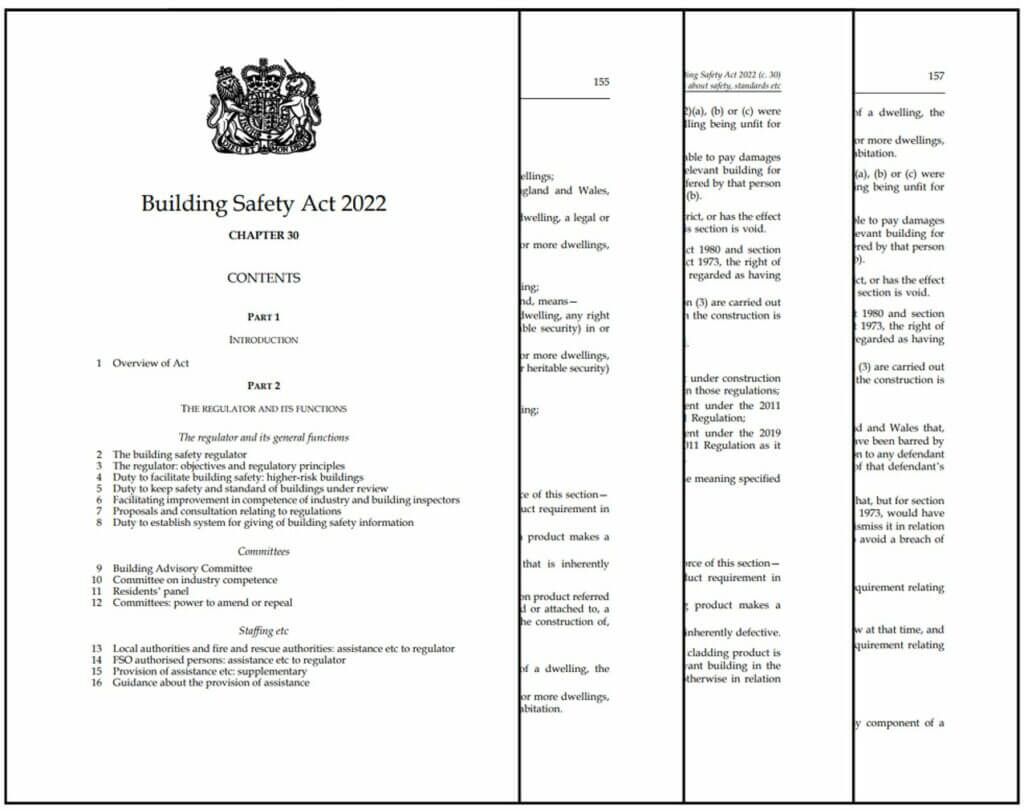
Since 28 June 2022, legal claims can be brought against manufacturers under sections 148[1] and 149[2] of Building Safety Act 2022 (‘the Act’). Under section 148, claims may be made where a product has been “installed in, or applied or attached to, a relevant building.”[3] and it can be demonstrated that the manufacturer took specific actions (including making misleading statements) that resulted in a relevant building being “unfit for habitation”.
Section 146 and Schedule 11[4] of the Act also states that the “Secretary of State may by regulations make provision in relation to the marketing and supply of construction products in the United Kingdom” called the “construction products regulations”. These may “prohibit the marketing or supply of construction products which are not safe products”.
Following this, in April 2023, the Department of Levelling Up, Housing and Communities published ‘Testing for a Safer Future An Independent Review of the Construction Products Testing Regime’[5] (‘the Morrell-Day Review’) which made recommendations about how to improve the regulation of construction products.
Since the Grenfell Tower Fire
Statutory duties for designers were introduced in October 2023 when Part 2A of the Building Regulations came into effect. Designers are now required to take “all reasonable steps to ensure the design work carried out by them (and by any workers under their control) is planned, managed and monitored” so that, if built in accordance with that design, the building would comply with all relevant requirements of the Building Regulations.
Phase 2 of the Grenfell Tower Inquiry (‘Phase 2’) further examined construction product testing and marketing and the Phase 2 report, issued on 4 September 2024, recommended that:
- “Steps be taken in conjunction with the professional and academic community to develop new test methods that will provide the information needed for such assessments to be carried out reliably”.
- “Copies of all test results supporting any certificate issued by the construction regulator be included in the certificate;
- “Manufacturers be required to provide the construction regulator with the full testing history of the product or material to which the certificate relates and inform the regulator of any material circumstances that may affect its performance; and
- “Manufacturers be required by law to provide on request copies of all test results that support claims about fire performance made for their products.”
The government responded to the Morrell-Day Review and the Phase 2 report by launching a consultation on the “Construction Products Reform Green Paper”[6] stating:
“Despite the significant reforms initiated in response to the Grenfell Tower tragedy, the government is clear that critical gaps persist in the construction products regulatory framework.”
At the time of writing, the government has signalled its intention to enact further construction product regulations. In the meantime, new testing methods are being developed.
Has a New Relationship Between Designers and Product Manufacturers Emerged?
Some manufacturers will no longer provide technical information without recording project details and caveating the reliance that can be placed on that information. This may include drawing the designer’s attention to the limitations of any tests that the product has undergone, and whether it will be used in an untested configuration.
Yet the designer must still rely on manufacturers’ information to develop designs and select the “right” product for the specific circumstances of each project.

So, What Practical Steps Can be Taken?
Understand What is Required:
Before taking any action, each designer must understand the scope of their design responsibilities relative to others and consider how they will demonstrate compliance with both the standard of care required by their contract with the client[7] and that required under Part 2A of the Building Regulations. Designers should not assume these responsibilities are the same across all projects, therefore reading and understanding the contract is imperative.
Provide Good Information:
No two projects are the same, and manufacturers can only give advice based on the information they receive. Clearly setting out project-specific criteria helps focus the designer on the principal considerations and enables them to assess which products might be suitable. This information can also serve as a benchmark against which manufacturers’ replies can be compared.
If it Isn’t Clear, Ask:
It is not what the designer believes the information says, but what the information actually says that matters.
If a clear answer is not received, further questions should be raised until the designer is satisfied that a reliable conclusion can be drawn.
Seek Advice From Multiple Sources:
Tempting as it may be to consult only the market-leader, designers should, whenever possible, approach several manufacturers and evaluate each product in context.
Designers must also review the industry guidance and advice that is available at the time of specification and where necessary, seek project-specific advice from independent bodies. The designer should inform the client in writing when further specialist advice is required.
Taking these steps ensures that designers receive a broader range of perspectives and advice upon which to form an opinion.
If a solution limits the choice of material, or if insufficient information is available, the designer should inform the client of the potential implications so that the client understands the risks associated with proceeding, and work collaboratively with the client to explore alternative options.
Certifications, Test Data, and ‘Desktop’ Studies:
In Martlet Homes Limited v Mulalley & Co Limited [2022] EWHC 1813 (TCC), His Honour Judge Stephen Davies reminded designers that a British Board of Agrément (BBA) “certificate is simply one of a number of … specified aids” that “may be used to establish the suitability of use of a material for a specific purpose”, and that the “BBA Certificates cannot be said to amount to a form of “guarantee” or “passport” to compliance with the Building Regulations.”
Designers must establish whether third-party product certification (BBA or equivalent) and product test data are current and applicable to the proposed build-up, and whether additional information is required, such as classification reports from full-scale tests in accordance with BS 8414.
It is often impractical or commercially unviable for manufacturers to undertake full-scale tests for every configuration for external walls; for example, the certification might not exist for the specified build-up. In such cases, an assessment in lieu of tests (AILOTs, ‘desktop assessments’) may be used “to establish by extrapolation how the system being assessed would perform if subjected to the same or a similar test”[8].
Both Building a Safer Future and the Phase 2 report criticised the use of AILOTs prior to Grenfell. Concerns centred on “the quality of the data available for that purpose and the competence of the person carrying it out”[9] such that some AILOTs were used to justify materials and components substitutions without sufficient evidence.
The Phase 2 report concluded that AILOTs “should be treated as only part of what is a complex exercise that requires information from various sources.”[10] Where AILOTs are necessary, they must be “properly evidenced” and based on relevant, existing test data, and undertaken by appropriate accredited bodies e.g. UKAS.
Designers may need to be persistent to be able to demonstrate that they have exercised the standard of care required in obtaining the information needed to make informed decisions. Where information is unavailable, they must carefully assess whether the product is appropriate for use and whether an alternative specification is necessary. Reliance should not be placed on the assumption that a product will pass future testing.
Passing Swiftly From Manufacturer to Designer to Client, Without Passing go:
It can be difficult for designers to verify the accuracy of technical information, and they may lack the competence to scrutinise certain test data. If operating outside their expertise, designers should advise the client and seek support from qualified professionals, such as fire engineers.
Nonetheless, designers should still consider carefully whether the information received passes a ‘fair reading’ and is not ‘an affront to common sense’. They should be able to demonstrate that they reviewed the advice before passing it to others who may reasonably rely on it.
For example, if incorporating a manufacturer’s standard details and specifications into project documentation, designers should review them as if they are its own, since, they may assume legal responsibility for that information. Even if the client instructs the designer to include it, this may not absolve the designer of liability. Limits of responsibility should be clarified in writing at the time of instruction.
Manufacturers’ responses often contain wide-ranging caveats intending to limit their liability. Designers should consider the caveats carefully alongside the technical information received.
Designers should also be cautious of relying solely on their own caveats in their drawings and specifications to limit their liability. Caveats that attempt to unilaterally amend the terms of the designer’s contract with the client may prove ineffective if challenged in court.
Finally – Records, Records, Records:
Records are essential for tracking decision-making and changes throughout the life of a building. Thankfully, most building projects do not end in dispute but when they do, the records kept play a significant role in resolving matters.
The client must only make arrangements for a digital record of ‘golden thread information’[11] to be retained on higher-risk buildings[12], not all buildings. Irrespective of literature, notes from meetings with manufacturers, current standards, certification, and other contemporaneous documentation relied upon.
Records are not kept solely for the designer’s benefit, but for those who may need to review them in the future, and understand the detail and reasoning behind the decisions made. Designers should be mindful that product literature changes and manufacturers’ websites are frequently updated, often without clear revision histories. The information they relied upon might not be readily available in the future.
Conclusion
In conclusion, manufacturer information remains a valuable resource, but designers must adopt sound strategies and draw on a range of resources to make informed decisions so that they may demonstrate that they have exercised the standard of care required.
Hawkins can support clients and designers by providing pre-loss risk management advice, and conducting investigations when failures occur. If you think that you may need the services of a forensic architect, please get in touch with us for a free consultation.
References & Footnotes
References:
[1] Section 148 relates to liability relating to construction products.
[2] Section 149 relates to liability for defaults relating to cladding products “attached to, or included in, the external wall of a relevant building”, and applies retrospectively as well as prospectively.
[3] A relevant building is a building that consists of a dwelling or contains two or more dwellings.
[4] Schedule 11 sets out the statutory framework for all construction products.
[5] Authored by Paul Morrell OBE and Anneliese Day KC.
[6] The consultation opened on 26 February 2025 and closed on 21 May 2025.
[7] Foreseeably ‘reasonable skill and care’.
[8] Paragraph 111.50 of the Grenfell Tower Inquiry Phase 2 report.
[9] Paragraph 111.51 of the Grenfell Tower Inquiry Phase 2 report.
[10] Paragraph 111.52 of the Grenfell Tower Inquiry Phase 2 report.
[11] Information about the building required under Regulation 31 of The Building (Higher-Risk Buildings Procedures) (England) Regulations 2023, and which will include the specifications.
[12] Higher-risk buildings are defined in the Higher-Risk Buildings (Descriptions and Supplementary Provisions) Regulations 2023.
Footnotes:
> Building a Safer Future: https://assets.publishing.service.gov.uk/media/5afc50c840f0b622e4844ab4/Building_a_Safer_Future_-_web.pdf
> Building Safety Act 2022: https://www.legislation.gov.uk/ukpga/2022/30/section/148
> Testing for a Safer Future An Independent Review of the Construction Products Testing Regime: https://assets.publishing.service.gov.uk/media/6440f2596dda69000d11e15e/Independent_Review_of_the_Construction_Product_Testing_Regime.pdf
> Construction Products Reform Green Paper: https://www.gov.uk/government/consultations/construction-products-reform-green-paper