 Italiano


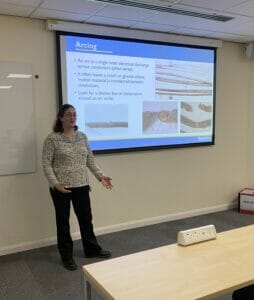
Fire and explosions specialist Lucy Pinkard was invited to present at the Airmic Island of Ireland Lunch & Learn, where she explored the growing risks posed by lithium‑ion batteries. Her session generated strong interest from attendees keen to understand the science behind these increasingly common devices. Following the event, Lucy expanded on her insights in a published article in Airmic News, offering a clear and accessible explanation of why lithium-ion‑ batteries present such complex challenges for risk professionals.
In her article, Lucy explains that lithium-ion batteries are now embedded in everyday life, powering everything from mobile phones and laptops to electric vehicles, e-bikes and e-scooters. Their high energy density makes them efficient but also potentially hazardous. She describes the phenomenon of thermal runaway, the self-heating process that can cause batteries to vent flammable gases, ignite, explode or release toxic byproducts such as hydrogen fluoride. These incidents, she notes, can result not only from manufacturing defects or design flaws, but also from environmental stress, incompatible chargers, DIY modifications and poor-quality components.
Lucy highlights the dramatic rise in fires linked to personal light electric vehicles (such as e-bikes and e-scooters), referencing data from the Office for Product Safety Standards and the significant increase in callouts recorded by the London Fire Brigade. She also underscores the challenges investigators face when examining fires involving lithium‑ion cells, as battery components can be projected across rooms and secondary fires may obscure the original source of ignition.
Her article stresses that the risk landscape is evolving quickly. She encourages risk professionals to take a proactive approach: identifying hazards early, ensuring that claims and investigations draw on specialist forensic expertise, promoting safe storage and charging practices, monitoring regulatory developments and incorporating battery risks into wider crisis planning. She also notes the potential for deliberate misuse, adding another layer of concern for organisations.
Lucy is an Associate Forensic Investigator and a specialist in fire and explosion investigation, with a background spanning forensic science, policing and academia. She began her career as an Analytical Scientist, before joining Avon and Somerset Constabulary as a Crime Scene Investigator, DNA Laboratory Analyst and Crime Scene Manager, working on major incidents, high-profile cases and arson investigations, and earning a Police commendation. She later completed a Masters in the Forensic Investigation of Explosives and Explosions at Cranfield University, focusing on lithium-ion battery thermal runaway. Lucy now lectures and trains investigators in fire and crime scene disciplines while supporting the development of future forensic scientists. She has investigated a wide range of domestic and commercial fires and is based in Hawkins’ Bristol office.
You can read Lucy’s article on page’s 27-28 in Airmic News Vol.06