 Italiano
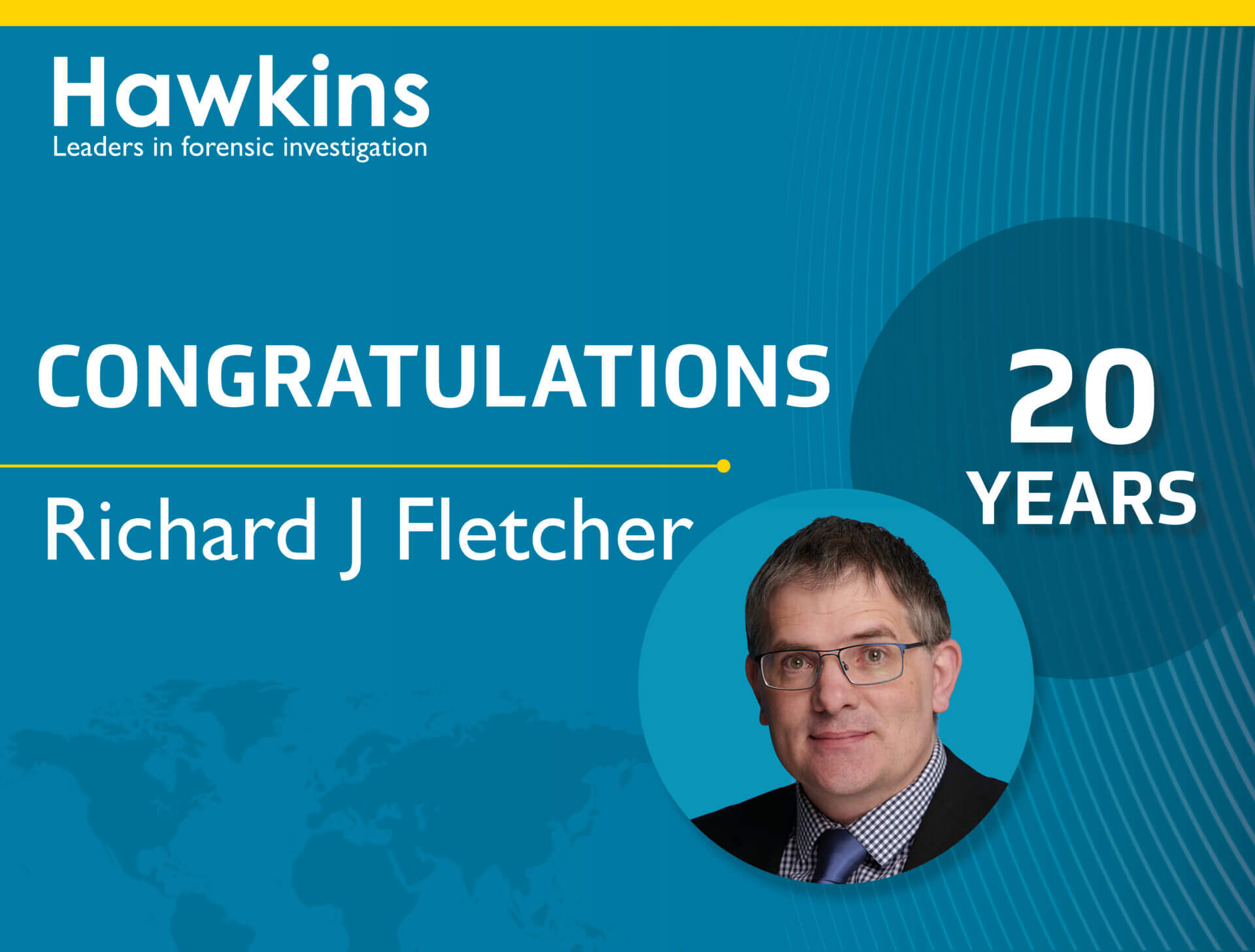

This month, we are proud to celebrate an incredible milestone as Dr Richard J Fletcher, Principal Associate and Fire & Explosions Expert in our Birmingham office, marks 20 years of service with Hawkins.
Since joining Hawkins in 2006, Richard has investigated more than 1,400 fire and explosion incidents, building a reputation for scientific rigour, impartiality, and technical excellence. His work has spanned everything from domestic fires and large-scale industrial losses to complex personal injury investigations involving fireworks.
Reflecting on his two decades at Hawkins, Richard said:
“I will never forget visiting my first fire scene 20 years ago with a colleague, seeing the destruction caused and then, over the years, learning how to identify the often subtle evidence that assists in determining the origin and cause of a fire. I can’t quite believe that it has been 20 years since I joined Hawkins!”
To mark the occasion, we sat down with Richard to look back on his career so far.
What brought you to Hawkins?
I obtained a BSc in Applied Chemistry from Portsmouth University, followed by a PhD focused on microbial corrosion. After that, I joined a small family-run company in Dorset, where I worked on non-destructive testing techniques, corrosion and materials failures.
While working there, I met and worked alongside Mr Rod Newbury, a former Managing Director of Hawkins, on the investigation of a rail accident. When that project came to an end, I approached Hawkins about potential opportunities, but there were no vacancies at the time. Around a year later, I received a call inviting me to interview for a Fire Investigator position in the Birmingham office. That opportunity ultimately led to what has now been a 20-year career with Hawkins.
How has your role evolved over the last 20 years?
The fundamental principles of fire investigation have not changed and never will. However, it has been fascinating to see how safety legislation has reduced some common causes of fire, such as smoking-related incidents and certain electrical failures.
At the same time, I’ve seen new fire risks emerge, particularly the significant rise in fires involving lithium-ion batteries.
Technology has also transformed the way we work. When I joined, I was fortunate to be given a digital camera while many colleagues were still using film. Smartphones soon followed, giving instant access to emails, and today we use tablets instead of paper. We also have access to drones, which allow us to safely view and document fire scenes from above.
Can you describe a case or moment that stands out as especially meaningful?
In 2012, just six years after joining Hawkins, I attended a fire involving a building approximately 140 metres long and up to 75 metres wide, with around three-quarters of the structure having collapsed. It remains one of the largest fire scenes that I have ever attended.
The investigation dominated the next two-and-a-half years of my career and ultimately resulted in a successful outcome for the insurer involved.
Another memorable experience was assisting with the investigation of an incident in the Channel Tunnel. We had to enter the tunnel at night, travelling on an open-topped service train. It was certainly one of the most unique locations I have ever visited.
I may also be one of the few people who can say they have investigated a fire caused by a medieval-style trebuchet!
What’s your favourite memory with your team?
The annual company meetings have always been a highlight. With colleagues spread across numerous offices, it’s a great opportunity to spend time together in person.
Over the years, I’ve had the chance to take part in activities I would probably never have experienced otherwise. Two that stand out are herding geese with a sheepdog and building rockets. One particularly memorable company meeting even featured a Spitfire aerobatics display during the evening entertainment.
What motivates you to come to work every day?
Fire investigation is unlike almost any other scientific profession. I often tell people that I rarely know what I’ll be doing the following week.
You always need to be prepared to change plans at short notice and attend a fire scene, and that unpredictability keeps the role interesting. Every investigation presents its own challenges and an opportunity to learn something new.
How has Hawkins supported you over the last two decades?
One of the things I value most about Hawkins is its commitment to training and professional development.
During my time here, I have been able to attend a wide range of specialist courses, including two pyrotechnics-related programmes:
-Practical Pyrotechnics – Stage/Theatre and Explosives Safety
– Handling Part 1 – TV/Film Pyrotechnics.
Hawkins has always recognised the importance of investing in training, and those opportunities have allowed me to broaden my expertise and develop specialist knowledge that has been invaluable throughout my career.
Read Richard’s article on Pyrotechnics here: Pyrotechnics in Engineering: Beyond Fireworks
Richard’s 20-year journey is a testament to his dedication, expertise and enthusiasm for fire investigation. From major industrial losses and unique challenges in the Channel Tunnel to investigating a fire caused by a trebuchet, his career at Hawkins has been anything but ordinary.
Congratulations, Richard, on this remarkable milestone, and thank you for your outstanding contribution to Hawkins over the last 20 years. We look forward to seeing what the next chapter brings.