
 Italiano



Vehicles as “Digital Witnesses”
Speaking at the Motor Accident Solicitors Society (MASS) conference, Hawkins’ road traffic collision experts, Robert Taylor and Adam Barrow, explored how data held by modern vehicles can transform an investigation. From speed, braking, and steering inputs to journey histories, door openings, safety-system activity, and video, today’s vehicles can act as “digital witnesses”, providing objective evidence that complements traditional collision reconstruction and biomechanical analysis.
Their message was clear: investigators should recover data quickly, before it is overwritten or lost, so that it can be used as an integral part of the broader forensic investigation. Vehicle data is most powerful when tested against physical evidence, established science, and the wider circumstances of a collision.
The three case studies they shared demonstrated why that combined approach matters.
Case Study 1: VW Golf & Toyota Yaris
A Volkswagen Golf was travelling along a 40 mph major road when a Toyota Yaris emerged from a side road and crossed its path. The Golf struck the Toyota’s side, causing catastrophic injuries to occupants of both vehicles.
The Golf’s event data recorder showed it accelerating from approximately 52 mph to 82 mph, before emergency braking reduced its speed to about 59 mph at impact; it also recorded that the rear nearside passenger was not wearing a seatbelt. Examination found that this passenger had heavily loaded and deformed the front seats from behind, helping explain the restrained driver’s neck and spinal injuries.
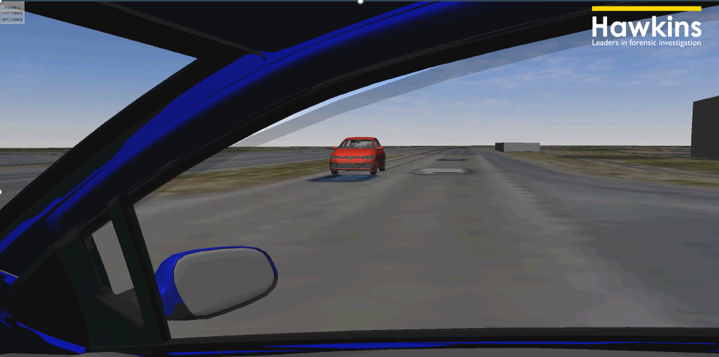
However, the Toyota’s data showed that it had not stopped at the junction and was accelerating into the Golf’s path before impact. Although the Toyota driver had a sightline of approximately 180 metres, simulation using both vehicles’ data indicated that the Golf was visible when the Toyota driver decided to accelerate, making liability more complex than speed alone suggested.
Case Study 2: Resolving a Disputed Driver Identity
Two relatives were involved in a crash after their vehicle travelled at about 60 mph on a 20 mph urban road, struck another car, and then collided with a lamp post. Relative #1 left the vehicle and claimed to have been the passenger, while Relative #2 was found unconscious on the driver’s side with severe brain and neck injuries; EDR data indicated that the driver had been belted but the passenger had not.
Infotainment data resolved the dispute: we were able to download journey data, including its GPS, its position over time, and details of which doors were opened that we were able to confirm the occupant positions: the driver’s door opened at Relative #1’s address, after which the vehicle travelled to Relative #2’s address, where only the front passenger door opened. This established that Relative #1 was driving and Relative #2 was the unrestrained passenger.
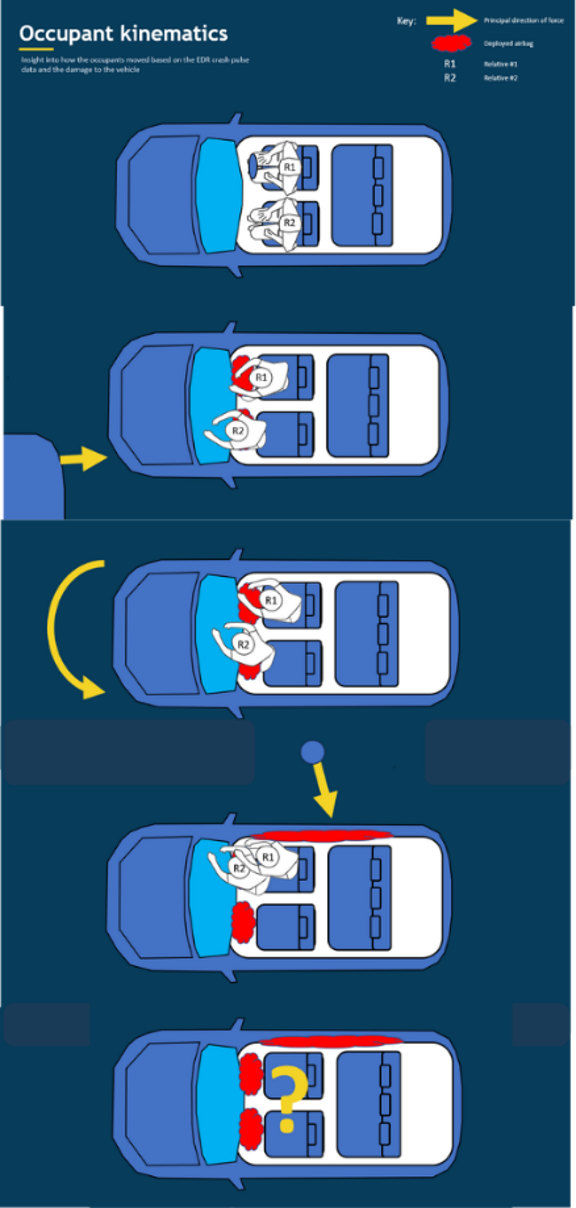
The biomechanical reconstruction showed the unrestrained passenger moving forward into the airbag, dashboard and windscreen during the initial impact. As the vehicle rotated and then struck the lamp post, both occupants moved toward the driver’s side, with the passenger effectively ending up on top of the driver. Although the vehicle’s later movement was too complex to reconstruct precisely, the combined infotainment, EDR, and CCTV evidence answered the key questions about seating positions and injuries.
Case Study 3: Pedestrian Airbag Failure
A pedestrian stepped between stationary traffic into the path of a Volvo V40 at night. The driver was below the speed limit, reacted promptly, and reduced the impact speed to approximately 20 mph, but the pedestrian suffered a traumatic brain injury after striking the lower windscreen.
The Volvo had an external pedestrian airbag and deployable bonnet designed to protect against precisely this type of head impact, but neither activated. Examination ruled out an incorrectly reset previous deployment and instead found evidence of an earlier low-speed collision that had damaged and detached part of the bumper’s pressure-sensor system.
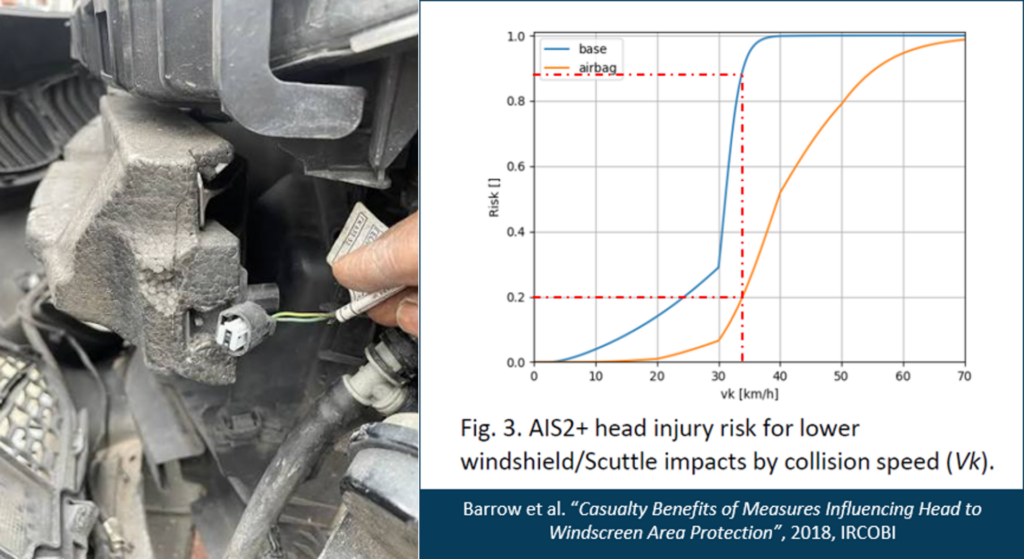
Onboard diagnostics showed that the resulting fault had been present for approximately six months without repair, causing the safety system’s failure. Data from a previous article published by Adam indicated that, at the relevant impact speed, the estimated risk of serious head injury was about 90% without the airbag, compared with approximately 20% if it had deployed.
Taken together, these three case studies demonstrate how vehicle data can transform the understanding of a road traffic collision. Event data recorder outputs can clarify speed, braking, restraint use and driver inputs; infotainment and journey records can establish movements and occupant positions; and diagnostic information can reveal faults that affected the operation of safety systems. When these digital records are interpreted alongside scene evidence, vehicle damage, CCTV, witness accounts and established scientific analysis, they can help investigators build a more complete and reliable account of events.
Why Context Matters
Vehicle data should never be considered in isolation. Its evidential value depends on prompt recovery, careful validation and expert interpretation within the wider circumstances of the collision.
The Value of Multidisciplinary Analysis
By combining collision reconstruction, vehicle-systems expertise and injury biomechanics, our investigators can move beyond establishing what happened. This approach can explain how the collision occurred, why particular injuries were sustained and whether a vehicle defect or safety-system failure affected the outcome.
Reaching Evidence-based Conclusions
For solicitors, insurers and others involved in road traffic collision cases, treating vehicles as potential “digital witnesses” can be crucial in resolving disputed facts, assessing liability and reaching robust, evidence-based conclusions. As these three diverse case studies demonstrate, vehicle data can be transformational in establishing exactly what occurred in a road traffic collision. Combining digital witness insights with traditional collision reconstruction and biomechanical analysis can provide a deeper understanding not only of the sequence of events, but also of how and why injuries were sustained.
Specialist Expertise Behind the Evidence
Robert Taylor is a Chartered Engineer, qualified Forensic Collision Investigator and Senior Associate at Hawkins. His work spans collision reconstruction, vehicle examinations, mechanical failures, CCTV and dashcam analysis, and the recovery and interpretation of Event Data Recorders. Before joining Hawkins, he spent nearly nine years at Millbrook Proving Ground, where he became a subject matter expert in active safety and worked extensively with Advanced Driver Assistance Systems, including Autonomous Emergency Braking and Lane Support Systems.
Adam Barrow brings more than 13 years’ experience in collision and safety research, with specialist expertise in collision investigation, injury biomechanics, and road safety analysis. His background includes leading collision research at the UK’s Transport Research Laboratory, attending live collision scenes, examining injury mechanisms, and vehicle safety technologies, and leading the National Highways Fatality Research Programme.
Together, Robert’s engineering and vehicle-systems knowledge and Adam’s expertise in biomechanics and injury analysis provide a multidisciplinary perspective. This enables them to determine not only how a collision occurred, but also how and why the resulting injuries were sustained.
If you need Adam or Robert to investigate a road traffic collision, or would like them to present to your organisation, please get in touch.